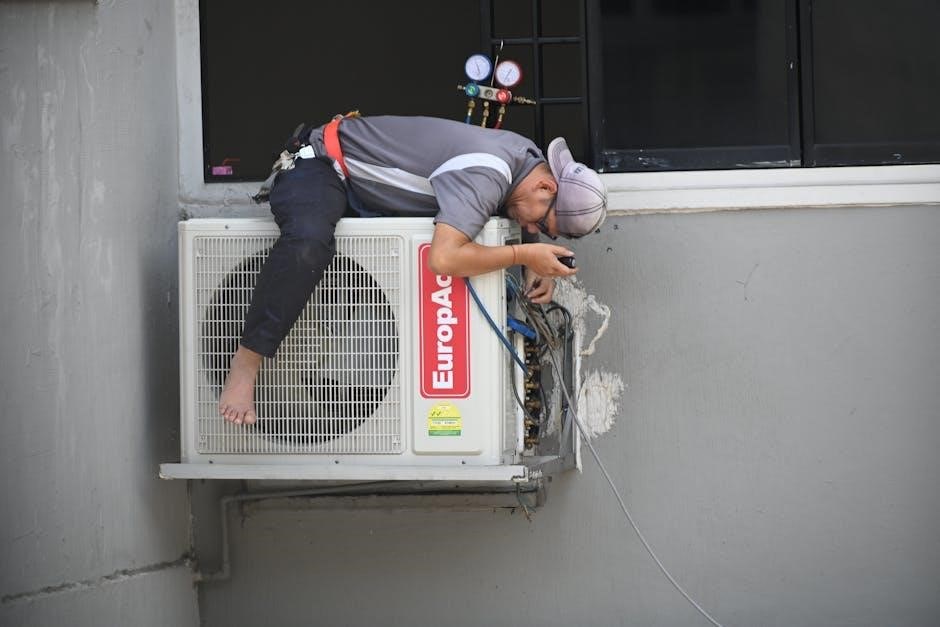
Mitsubishi Industrial Air Conditioner Manual: A Comprehensive Guide
This manual details Mitsubishi’s HVAC systems‚ covering operation‚ maintenance‚ and troubleshooting—from Home Depot insights to Mitsubishi community forums and global dealership networks.
Understanding Your System
Mitsubishi industrial AC systems represent a significant investment‚ demanding thorough comprehension for optimal performance and longevity. This section bridges the gap between complex technology and user accessibility.
Familiarize yourself with the diverse range of Mitsubishi’s HVAC solutions‚ drawing insights from resources like Home Depot and dedicated online forums. Understanding the interplay between components—indoor and outdoor units‚ control systems—is crucial.
Recognize that Mitsubishi actively acknowledges collaborations with Renault/Nissan‚ impacting models like the ASX and Outlander. This knowledge‚ alongside diligent manual review‚ empowers effective operation and maintenance.
Mitsubishi’s HVAC solutions‚ spanning from energy companies to automotive partnerships‚ deliver robust cooling and heating—supported by extensive community forums and dealerships.
A. Overview of Mitsubishi’s HVAC Solutions
Mitsubishi’s industrial air conditioning systems are renowned for their efficiency and reliability‚ serving diverse sectors like energy‚ materials‚ and manufacturing. From Antero Midstream to Alcoa‚ industries depend on their robust performance. The company’s offerings extend beyond core cooling‚ encompassing advanced controls and integrated solutions.
Notably‚ Mitsubishi collaborates with automotive brands like Renault and Changan‚ showcasing technological synergy. Support networks‚ including online forums and authorized suppliers‚ ensure comprehensive assistance. These systems are designed for longevity‚ backed by detailed manuals and readily available parts‚ as highlighted by resources like Home Depot and global Mitsubishi communities.
B. Key Features and Benefits
Mitsubishi industrial AC systems boast superior energy efficiency‚ reducing operational costs for businesses like Weatherford International and Ovintiv. Advanced features include precise temperature control‚ adaptable to diverse industrial environments – from materials processing (Alcoa‚ ATI Inc.) to aerospace (AeroVironment).
Benefits extend to enhanced reliability‚ minimizing downtime‚ and simplified maintenance‚ supported by readily available parts and detailed manuals. The integration with remote control systems‚ discussed in online forums‚ offers convenient monitoring and adjustments. Mitsubishi’s commitment to innovation‚ evident in collaborations with automotive partners‚ translates to cutting-edge HVAC solutions.

II. Safety Precautions & Warnings
Prioritize electrical safety and proper refrigerant handling‚ adhering to guidelines for components like those found in Mitsubishi ASX and Outlander systems.
A. Electrical Safety Guidelines
Always disconnect power before servicing any electrical components‚ referencing wiring diagrams for Mitsubishi systems. Qualified technicians should only perform electrical repairs‚ ensuring adherence to local and national codes.
Inspect wiring for damage regularly‚ and never operate the unit with frayed or exposed wires. Grounding is crucial for safety; verify proper grounding connections.
Avoid working on live circuits‚ and utilize appropriate personal protective equipment (PPE)‚ like insulated gloves and eyewear. Be aware of high-voltage components within the outdoor and indoor units‚ similar to those discussed in Mitsubishi forums.
B. Refrigerant Handling Procedures
Mitsubishi AC systems utilize refrigerants requiring EPA certification for handling‚ adhering to strict environmental regulations. Recovery and recycling are mandatory; never vent refrigerant into the atmosphere.
Properly label refrigerant containers and store them in a well-ventilated area‚ away from heat sources.
When servicing‚ use approved recovery equipment and follow established procedures for leak detection and repair‚ as discussed within Mitsubishi technical communities. Technicians must wear appropriate PPE‚ including eye protection and gloves‚ during refrigerant handling.

III. System Components & Identification
This section details indoor‚ outdoor‚ and control unit parts‚ referencing Mitsubishi diagrams for precise identification—crucial for maintenance and repair procedures.
A. Indoor Unit Components
The indoor unit houses vital components like the evaporator coil‚ responsible for heat exchange‚ and the blower fan‚ circulating conditioned air throughout the space.
Air filters‚ crucial for maintaining air quality‚ are easily accessible for cleaning or replacement. Expansion valves regulate refrigerant flow‚ while sensors monitor temperature and humidity levels.
Drain pans collect condensation‚ preventing water damage‚ and the unit’s casing provides structural support and insulation. Understanding these components is fundamental for effective troubleshooting and maintenance‚ ensuring optimal performance and longevity of your Mitsubishi system.
B. Outdoor Unit Components
The outdoor unit contains the compressor‚ the heart of the cooling cycle‚ responsible for circulating refrigerant. Condenser coils dissipate heat absorbed from indoors‚ aided by a fan for efficient airflow.
A capillary tube or expansion valve controls refrigerant pressure‚ while a reversing valve enables heating mode operation. Electrical components‚ including a contactor and capacitor‚ manage power distribution.
The unit’s casing protects internal parts from the elements‚ and vibration isolators minimize noise. Familiarity with these components is key for diagnosing issues and performing necessary repairs‚ maintaining system efficiency.
C. Control System Components
Mitsubishi’s control systems utilize a central control board‚ the brain of the operation‚ managing all functions. A user interface‚ often a wired or wireless remote‚ allows temperature and fan speed adjustments. Sensors monitor indoor and outdoor temperatures‚ relaying data to the control board for optimal performance.
Communication wiring connects indoor and outdoor units‚ enabling synchronized operation.
Safety features‚ like high-pressure switches‚ protect the system from damage. Understanding these components is crucial for troubleshooting operational issues and ensuring efficient climate control within industrial settings.
IV. Operating Instructions
Proper startup involves powering on both indoor and outdoor units‚ setting desired temperatures via the remote‚ and verifying fan speed settings for optimal cooling or heating.
A. Powering On/Off the Unit
To initiate operation‚ ensure the main power supply to both the indoor and outdoor units is connected and switched on. Press the “ON/OFF” button on the remote control or the unit’s control panel. A confirmation indicator light will illuminate‚ signifying the system is active.
For shutdown‚ repeat the process – pressing the “ON/OFF” button. Allow a brief period for the system to complete its shutdown sequence before disconnecting power‚ if necessary. Avoid frequent cycling of the unit for optimal longevity and efficiency. Always consult the full manual for specific model instructions.
B. Setting Temperature and Fan Speed
Temperature adjustment is achieved via the remote control’s “TEMP UP” and “TEMP DOWN” buttons‚ or directly on the unit’s control panel. The display will show the set temperature. Fan speed is controlled using the “FAN SPEED” button‚ offering options like Auto‚ Low‚ Medium‚ and High.
“Auto” mode automatically adjusts fan speed based on the temperature difference. For precise control‚ select a specific fan speed. Remember‚ lower fan speeds conserve energy‚ while higher speeds provide quicker cooling or heating. Refer to your model’s manual for detailed settings.
C. Utilizing Remote Control Functions
The remote control offers comprehensive system management. Beyond temperature and fan speed‚ explore modes like “Cool‚” “Heat‚” “Dry‚” and “Auto.” The “Mode” button cycles through these options. Utilize the “Timer” function for scheduled operation‚ setting start and stop times.
The “Swing” function adjusts louvers for optimal airflow distribution. Some models feature an “Economy” mode for energy savings. Ensure the remote has fresh batteries for reliable operation. Refer to the manual for specific button functions and advanced features unique to your Mitsubishi unit.
V. Basic Maintenance Procedures
Regular cleaning of air filters and coils is crucial for optimal performance and longevity of your Mitsubishi industrial AC system‚ ensuring efficient operation.
A. Air Filter Cleaning & Replacement
Maintaining clean air filters is paramount for efficient operation and air quality. Regularly inspect filters – typically monthly – for dust and debris accumulation. Washable filters can be vacuumed or rinsed; disposable filters require replacement.
Always power off the unit before filter access. Locate the filter access panel‚ usually on the indoor unit. Remove the filter and note its orientation for correct reinstallation. A clogged filter restricts airflow‚ reducing cooling/heating capacity and potentially damaging the system.
Replace disposable filters with the manufacturer’s recommended type. Clean washable filters thoroughly and allow them to dry completely before reinstalling. Proper filter maintenance extends the lifespan of your Mitsubishi AC system.
B. Coil Cleaning (Indoor & Outdoor)
Dirty coils significantly reduce AC efficiency. Both indoor (evaporator) and outdoor (condenser) coils require periodic cleaning. Begin by disconnecting power to the unit. For the indoor coil‚ access requires panel removal; use a soft brush or vacuum to remove loose debris.
Apply a commercially available coil cleaner‚ following product instructions carefully. Rinse thoroughly with water‚ avoiding electrical components. The outdoor coil can be cleaned similarly‚ but may require a garden hose with a gentle spray nozzle.
Bent fins impede airflow; carefully straighten them with a fin comb.
VI. Troubleshooting Common Issues
Diagnose cooling or heating failures‚ decipher error codes‚ and identify unusual noises—common problems addressed with practical solutions for optimal Mitsubishi AC performance.
A. Unit Not Cooling/Heating
If your Mitsubishi industrial AC isn’t cooling or heating‚ first verify the power supply and thermostat settings. Check the air filter for obstructions – a clogged filter restricts airflow‚ impacting performance. Inspect the outdoor unit for ice buildup‚ potentially indicating a refrigerant issue or airflow restriction.
Confirm the compressor is running; listen for its operation. Examine the condenser coils for dirt or debris. If issues persist‚ consult error codes displayed on the unit‚ referencing the manual for specific interpretations. Remember‚ complex repairs require a qualified technician to avoid further damage or safety hazards.
B. Error Codes and Their Meanings
Mitsubishi industrial AC units utilize error codes to diagnose issues. A code like “E1” might indicate a sensor malfunction‚ while “E2” could signal a communication error between components. “E3” often points to compressor problems‚ demanding professional attention. Refer to your specific model’s manual for a complete list and detailed explanations.
Ignoring error codes can lead to escalating damage. Document the code displayed before attempting any resets. Some codes may require a technician’s expertise for accurate diagnosis and repair‚ ensuring the system’s longevity and efficient operation.
C. Unusual Noises and Their Causes
Unusual sounds from your Mitsubishi AC signal potential problems. Rattling often indicates loose components‚ while hissing could mean a refrigerant leak – requiring immediate professional attention. Clicking sounds may stem from relay issues or electrical faults. A grinding noise frequently points to compressor failure‚ a costly repair.
Ignoring these sounds can worsen the issue. Regularly inspect for loose parts and debris. If the noise persists‚ consult a qualified technician for diagnosis and repair‚ preventing further damage and ensuring optimal system performance.
VII. Advanced Troubleshooting & Repair (Qualified Technician Only)
Complex repairs—refrigerant leaks‚ compressor issues‚ and electrical diagnoses—demand specialized tools‚ expertise‚ and adherence to safety protocols; professional service is crucial.
A. Refrigerant Leak Detection & Repair
Identifying refrigerant leaks requires specialized equipment like electronic leak detectors and bubble solutions‚ pinpointing the source is paramount. Repair involves brazing or replacing damaged components‚ followed by a thorough vacuuming of the system to eliminate moisture and non-condensables.
Subsequently‚ precise refrigerant charging—according to the unit’s specifications—is essential for optimal performance. Leak testing after repair confirms the fix. Improper handling violates environmental regulations and compromises system efficiency. Qualified technicians must adhere to EPA guidelines and possess proper certification for refrigerant management‚ ensuring both safety and compliance.
B. Compressor Issues
Compressor failure manifests as a lack of cooling or heating‚ unusual noises‚ or tripped circuit breakers; Diagnosis involves checking electrical connections‚ capacitor functionality‚ and refrigerant levels. Internal compressor damage often necessitates replacement‚ a task for certified technicians only.
Overheating‚ caused by restricted airflow or refrigerant issues‚ can also lead to compressor burnout. Proper lubrication is critical; insufficient oil can cause seizing. Always verify the compressor’s voltage and amperage draw against the manufacturer’s specifications before concluding a fault.
C. Electrical Component Diagnosis
Electrical faults within Mitsubishi AC units require a systematic approach. Begin by inspecting the control board for burnt components or loose connections. Utilize a multimeter to test capacitors‚ relays‚ and transformers for continuity and proper voltage. Check wiring for damage‚ corrosion‚ or improper grounding.
Faulty sensors can provide incorrect readings‚ impacting system performance. Always disconnect power before any electrical inspection. Refer to wiring diagrams for accurate component identification and testing procedures; safety is paramount when dealing with electrical systems.
VIII. Wiring Diagrams & Schematics
Access detailed schematics for precise component locations and connections. Understanding symbols is crucial for effective troubleshooting and accurate electrical diagnosis of the unit.
A. Accessing Wiring Diagrams
Locating the correct wiring diagram is paramount for any electrical work. Mitsubishi typically includes these diagrams within the unit’s service panel‚ often secured with a screw or clip. Alternatively‚ detailed schematics are frequently available through authorized Mitsubishi parts suppliers‚ both online and via direct request.
Digital copies may also be accessible on Mitsubishi’s professional support website‚ requiring registration and model-specific information. Ensure the diagram corresponds precisely to your unit’s serial number to avoid errors during diagnosis or repair. Incorrect diagrams can lead to misidentification of components and potentially hazardous situations.
B. Understanding Schematic Symbols
Mitsubishi wiring diagrams utilize standardized electrical symbols for clarity. Common symbols include circles representing capacitors‚ rectangles for relays‚ and zig-zag lines denoting resistors. Understanding these is crucial for tracing circuits and identifying components. A solid line signifies a wire‚ while a dashed line often indicates a control signal.
Pay close attention to grounding symbols and voltage indicators. Familiarize yourself with the legend accompanying each diagram‚ as symbol variations can occur. Proper interpretation prevents misdiagnosis and ensures safe‚ effective repairs.
IX. Parts List & Ordering Information
Locate precise part numbers using the detailed parts list. Order replacements through authorized Mitsubishi suppliers‚ ensuring compatibility and maintaining system performance and warranty validity;
A. Locating Part Numbers
Identifying the correct part number is crucial for ensuring compatibility and a successful repair. Begin by consulting the detailed exploded view diagrams within this manual‚ specifically tailored to your Mitsubishi industrial AC unit model. These diagrams clearly illustrate each component and its corresponding part number.
Alternatively‚ the unit’s original nameplate‚ typically found on the indoor or outdoor unit‚ often lists key component part numbers. When contacting authorized Mitsubishi parts suppliers‚ having the full model number and serial number readily available will expedite the process and minimize errors.
Online resources‚ including Mitsubishi’s official parts database (if available)‚ can also assist in locating part numbers. Always double-check the part number against the manual’s diagrams before placing an order.
B. Authorized Mitsubishi Parts Suppliers
To guarantee genuine Mitsubishi parts and maintain your system’s warranty‚ it’s essential to source components from authorized suppliers. A comprehensive list of authorized distributors can be found on the official Mitsubishi HVAC website‚ categorized by region for convenient access.
Many local HVAC wholesalers also carry Mitsubishi parts‚ offering the benefit of immediate availability and potential cost savings. Home Depot and other large retailers may stock common replacement parts‚ but verifying authenticity is crucial.
Always inquire about return policies and warranty coverage when purchasing from any supplier.
X. Warranty Information
Mitsubishi’s warranty covers defects in materials and workmanship; coverage details and claim procedures are outlined in the manual and online resources.
A. Coverage Details
Mitsubishi’s industrial AC warranty typically covers components against manufacturing defects for a specified period‚ often differing based on the part and system type. Compressor warranties frequently extend longer than other components. Labor costs for repairs during the initial warranty period are often included‚ but may have limitations.
Extended warranties are often available for purchase‚ providing continued coverage beyond the standard term. The warranty does not cover damage resulting from improper installation‚ misuse‚ lack of maintenance‚ or acts of nature. Detailed terms‚ conditions‚ and exclusions are fully documented within the official warranty statement included with your unit.
B. Claim Procedures
To initiate a warranty claim for your Mitsubishi industrial AC‚ first contact an authorized Mitsubishi HVAC dealer or service provider; Have your unit’s model and serial number‚ purchase date‚ and a detailed description of the issue readily available. The dealer will diagnose the problem and determine if it’s covered under warranty.
If approved‚ the dealer will submit the claim on your behalf‚ including necessary documentation like proof of purchase and the diagnostic report. Mitsubishi will then review the claim and authorize repairs or replacements as appropriate. Retain all records related to the claim for your reference.